
Best Tools to Make Hanukkah Latkes
We took a new approach to these traditional favorites in a home kitchen experiment
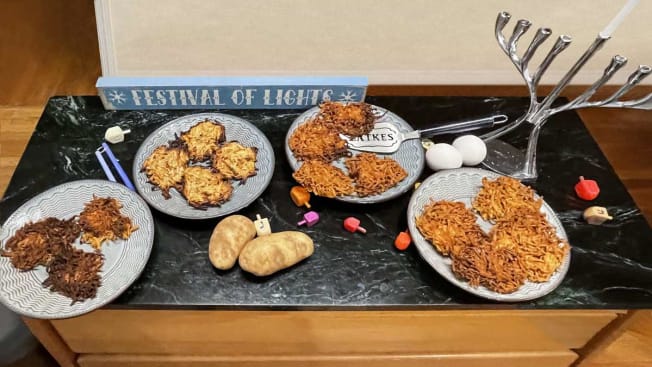
Can you guess which latke batch was fried in a nonstick pan? In stainless steel? Cast Iron? An air fryer? Read on to find out which delivered the most delicious latkes.
By Tobie Stanger
Paul Hope contributed to this article
Fried food doesn’t get much respect, at least from anyone who prizes their health. But eating latkes—potato pancakes fried in oil for the Jewish holiday of Hanukkah—is worth the risk of censure from the food police. When it’s dark and cold outside, there’s nothing like lighting the candles and loading your plate with the warm crispy-outside-soft-inside goodness of this holiday delicacy—ideally with homemade applesauce and sour cream on the side.
The recipe for latkes is simple, but varies a bit from cook to cook. You’ll need a fair amount of oil for the frying (some recipes call for as much as ¼ inch in the pan). The basic batter is grated potatoes (wrung out to remove extra liquid); one or two beaten eggs; a bit of all-purpose flour, potato starch or matzo meal; salt (ideally Kosher); and pepper to taste.
(If you need more guidance than that, check out variations from Joan Nathan, the Julia Child of Jewish cooking; The New York Times’ Melissa Clark; and Tori Avey, who goes native, using delicious-but-deadly schmaltz—chicken fat—for frying.)
The variations on the basic recipe are endless. Including raw, diced yellow onion in the batter is traditional. Adding shredded root veggies like carrots or beets can provide texture and color. You can even stir in Middle Eastern-style spices, as my CR colleague Paul Hope did with a recent batch.
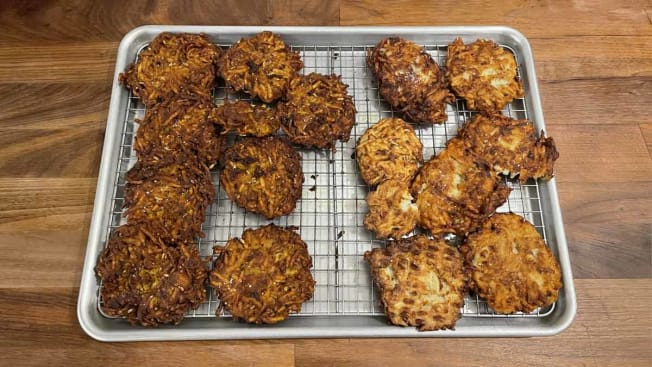
A tray of traditional fried latkes. Those on the left get their color from the addition of Middle-Eastern spices to the batter.
Photo: Paul Hope/Consumer Reports
True latke lovers, Paul and I both have been making our moms’ recipes for decades—though as a culinary school grad and all-around gourmet cook, he knows far more about proper pancake production. Yet we both had some surprising revelations when we tried making latkes in our home kitchens using both traditional and not-so-traditional methods. Read on to join us as we quibble over white versus yellow potatoes, olive versus canola oil, box graters over food processors, and even air fryers over frying pans. Whoever’s side you choose, you’ll find CR’s top-rated picks for all the tools you need to make to fry up superb Hanukkah latkes, no guilt involved.
What Kind of Potatoes Do You Use for Latkes?
Paul: I always use Russets. They have a high starch content. We were taught in culinary school that they fry better than other types of potatoes. Yukon Golds are lower in starch, but still okay to use.
Tobie: I’m using Russets at your suggestion, and grating with the skin on. It’s for texture and vitamins, right?
Paul: Totally. It’s also easier than peeling.
We agree: Russets, with skin on.
What Kind of Oil Do You Use for Latkes?
Tobie: I normally would cook with my usual oil—olive oil—but you recommend canola.
Paul: That’s what I use. You also could use safflower oil.
Tobie: Why are those oils a better choice than olive oil?
Paul: It’s the smoke point of olive oil, the temp at which it starts to smoke in a pan. It’s far lower than frying oils.
Tobie: That could explain why my kitchen got so smokey in the past!
We agree: Canola or safflower oil … we’ll save the olive oil for pizza.
Do you Use a Box Grater or Food Processor to Make Latkes?
Tobie: I like hand-grating. It’s a lot more effort, and my shoulder and upper arm feel it the next day. But it creates a less uniform shred, which I think makes for a nicer texture for the batter.
Paul: What you say makes sense: The gratings are coarser and more rustic. I also like that you can do it with a $3 tool. But the food processor makes it a less daunting task. And if you’re doing a bigger batch, you don’t have to worry about the batter getting dark from oxidation while you’re cooking.
Tobie: That’s true! And I’m not noticing much difference in texture between the finished products. Though there’s something to be said for tradition…
We agree: Food processor. Box grater if you have no food processor or want to feel the burn like Grandma did.
Which Type of Frying Pan Do You Use for Latkes?
Tobie: I tried frying the pancakes in three pans—nonstick, high-quality stainless steel, and cast-iron. I don’t see much difference between the latkes made in the stainless and the cast-iron pan, but I found the nonstick pan harder to control, temperature-wise. My pancakes from that pan are way too dark—a bit burnt, to be honest.
Paul: That doesn’t surprise me. On a cheap nonstick, it’s typically aluminum or anodized aluminum, plus the nonstick coating on the cooking surface. Aluminum is highly reactive so it’s quick to heat up. But it’s also more prone to cooling down when you add the latke batter, and then heating up again quickly. The heat level varies, like getting into a shower with a very sensitive control. It’s hard to get the right balance.
Tobie: So what did you use?
Paul: I used high-quality, heavy stainless steel and cast-iron pans, and I didn’t see much difference, either. Mine came out dark, but I tend to like them that way.
We agree: Cast iron or high-quality stainless steel will yield the crispiest, lightly browned pancakes.
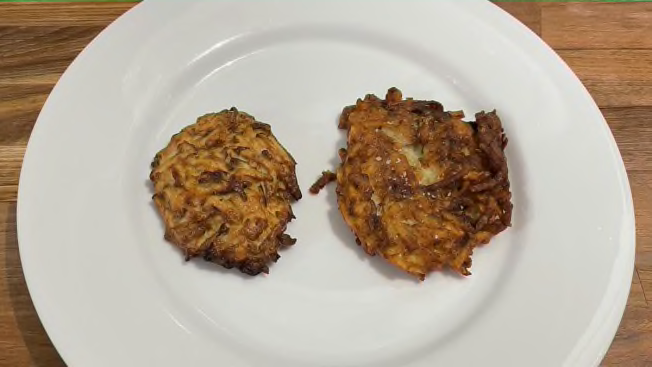
An air-fried latke, left, alongside a traditional pan-fried latke, right. Both emerged crisp, brown, and pleasantly mealy, with good potato flavor.
Photo: Paul Hope/Consumer Reports
Can You Make Latkes in an Air Fryer?
Paul: I’d never used an air fryer for latkes before, but I tried making them with an air fryer this year. I preheated it to 400 degrees for 5 minutes. Then I quickly pulled the basket, and sprayed the bottom and sides with cooking spray. I’d pre-smushed the latkes on a cookie sheet, so they were ready to be put in the basket. I cooked them for a total of 18 minutes. I flipped them once, I think about ⅔ of the way through. I wanted to give them enough time to become solid enough before I flipped them.
Tobie: I tried this too, but I used a toaster oven with an air fryer function. I also preheated it to 400 degrees. I took the mesh shelf while the air fryer preheated, used cooking spray on it, and smushed the latkes right there on the shelf. I should have done what you did, though—smushing on a platter first—because the pancakes were hard to flip. Once I flipped them—after about 10 minutes—I brushed oil on the tops and cooked for a few more minutes. They didn’t come out as dark as the other latkes, which I actually liked. They were a bit softer in the middle, and not as crispy as the fried ones.
Paul: You’re right, the air-fried latkes weren’t as crispy! But I was pleasantly surprised. The air-fryer latkes got eaten up faster than the others did—because there’s only so much fried food you want on a given day.
Tobie: I felt I had more control over how brown they got than I did with the frying pans. But it’s not great for a big group, because you can only do just a few at a time. And they do take more time than pan frying.
We agree: For big, traditional batches, frying. For a small nosh that uses far less oil, air frying (and zero guilt).
Best Tools for Making Hanukkah Latkes
Cast-Iron Frying Pan (Coated)
Tramontina 80131/066DS
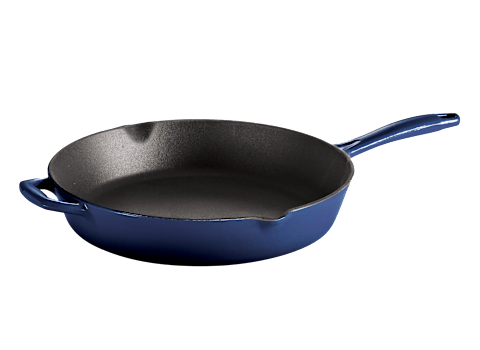
CR’s take: The 12-inch Tramontina 80131/066DS cast-iron frying pan, with a coated cooking surface, is a good choice for large-scale latke production. CR found it cooked evenly across its entire surface. In CR’s tests, it excelled at searing steak and browning scallops; we also baked cornbread in it. And it’s easy to clean.
Stainless Steel Frying Pan
All-Clad D5 Stainless Brushed 5-ply Bonded
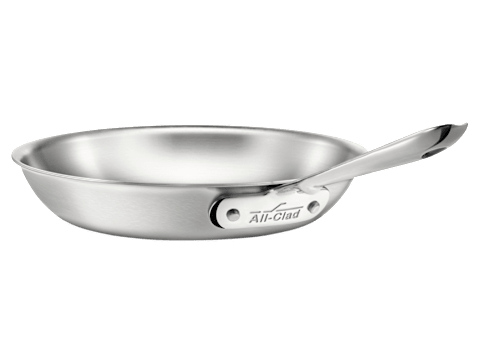
CR’s take: The 10-inch All-Clad D5 Stainless Brushed 5-ply Bonded frying pan earned an excellent score for evenness and a very good mark for food release, two big pluses for making potato pancakes. Its handle was sturdy, and handle temperature during heating also stayed uniform. Clean-up was very good. This pan is oven-safe to 600 degrees, and as a bonus can be used on an induction cooktop. It has a limited lifetime warranty.
Air Fryer
Wolfgang Puck 9.7QT Air Fryer Stainless Steel, Large Single Basket Design
CR’s take: With a measured capacity of 8.2 quarts, the Wolfgang Puck 9.7QT Air Fryer is the largest air fryer CR tested that earns a recommendation, so you can fit a fair number of latkes in its basket. It aced our tests for user-friendliness and did well on our noise and cleaning tests, too. This model comes with a 1-year warranty, which is similar to most of the other air fryers we recommend. If you’re cooking for a crowd or a large family, this is the best air fryer CR tested to do the job right.
Toaster Oven with Air-Fryer Function
Breville Smart Oven Air Convection BOV900BSSUSC
CR’s take: The Breville Smart Oven Air Convection BOV900BSSUSC is not your run-of-the-mill toaster oven. It’s intuitive to use, according to our lab tests. Among its many designated options are roasting, dehydrating, slow cooking, and air frying—to use for latkes and more. In a home evaluation, it nailed tasks you normally wouldn’t expect in a toaster oven, including turning out a perfect sugar cookie (on "cookies" mode) as well as a margherita pizza with a fantastic crust ("pizza" mode). While most toaster ovens fit only a single dish, this model can handle a protein and two side dishes. One caveat? It took our staffer 7 minutes to get a decent char on two slices of toast for breakfast. You’ll need a good amount of counter space (it’s 13"H X 21"W X 18"D) for this model — but for most singles and couples, it could replace your standard oven.
Food Processor
Breville Sous Chef BFP800XL/A
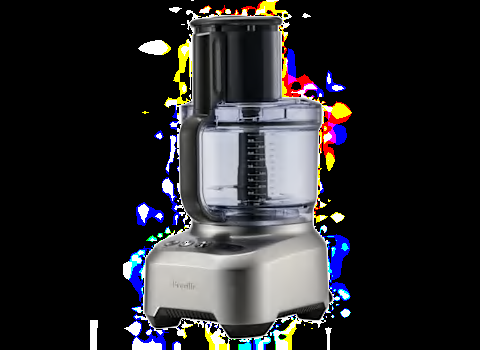
CR’s take: This 16-cup food processor from Breville tops CR’s Ratings for its superb slicing, shredding, and grating—so you’ll make quick work of all those Russets. For all its power and performance, it’s also surprisingly quiet. Added features include an adjustable slicing disk, mini-bowl attachment, and whipping blade. Standing 18 inches tall, it is larger than most food processors, plus the container for its various blades and accessories will take up additional storage space.
Consumer Reports is an independent, nonprofit organization that works side by side with consumers to create a fairer, safer, and healthier world. CR does not endorse products or services, and does not accept advertising. Copyright © 2022, Consumer Reports, Inc.